Nervous About the Dentist? Dental Anxiety Help in Brisbane
Scared of the Dentist? You’re Not Alone, and You’re Not Being Dramatic
You know the feeling. The appointment is three weeks away and you are already thinking about it. The night before, you sleep badly. In the waiting room your hands are cold, your mouth is dry, and a small part of you is quietly working out whether you could just leave and reschedule. If that sounds familiar, you are in very good company.
Around one in six Australian adults reports moderate to high dental fear, and a fair share of the people who walk through our door on Turbot Street have put off a visit for years because of it. Some arrive having rehearsed an apology. Nobody needs to apologise here.
I am Peter Wong. I have been in dentistry for more than 30 years and at this same Spring Hill practice for more than 20, and a large part of what I do is look after people who were frightened of dentists long before they met me. Here is the thing I want you to hear first: fear of the dentist is not a character flaw. It is a learned response, and learned responses can be unlearned. Usually slowly. Usually with someone who is not going to rush you.
What Dental Anxiety Actually Is (And Why Your Body Does It)
Dental anxiety is a real physical event, not a failure of willpower. When your brain reads a dental chair as a threat, the amygdala does exactly what it does with any threat: it pushes adrenaline into your bloodstream. Heart rate climbs, breathing goes shallow, hands sweat, the stomach turns over. Some people go the other way and feel faint, because the vagus nerve drops their blood pressure instead. Others freeze completely, or find their gag reflex is suddenly on a hair trigger. None of that is you being silly. That is your nervous system doing its job in the wrong place.
The reason a dental chair sets it off is usually not the dentistry. In my experience the same handful of causes come up again and again:
- A bad experience as a child. Often a painful extraction, or being held down. Remembered with surprising clarity decades later.
- Pain, or the memory of it. And the belief that the next visit will feel the same as the last one.
- Needles. A genuine phobia for some people, and not one that responds to being told to relax.
- Loss of control. Lying back with your mouth open, unable to speak, is a vulnerable position. For some people that is the whole problem.
- Embarrassment. Years of avoidance, broken teeth, bleeding gums, and the fear of being told off like a child.
- The sounds and smells. The drill, the suction, the eucalyptus. Sensory memory is powerful and it does not check the facts.
- Cost fear. The worry that saying yes to a check-up means signing up for something you cannot afford.
- Gag reflex. Involuntary, unpredictable, and frequently humiliating for the person living with it.
Working out which of these is yours changes what we do about it. “I hate the dentist” is a starting point. “I hate the drill noise and I need to know I can stop” is a plan.
One thing worth saying plainly: waiting rarely makes the fear smaller. Most people who have put off a visit for five years find the appointment itself takes less time than the worrying did. What waiting does do is give the problem room to grow, which is why we so often meet frightened patients who arrive with more going on than they needed to have.
The Fear Nobody Talks About: Being Judged
Ask a room of nervous patients what they are actually scared of and a surprising number say some version of “the lecture”. Not the drill. The telling off. The sigh, the raised eyebrow, the comment about how long it has been.
I have never once seen a telling-off improve anybody’s teeth. What improves teeth is a person finally feeling safe enough to sit in the chair. So you will not hear “you should have come sooner” from me or from our Teeth Fairies. It is not useful, and it is not even accurate. You are here now, and now is the only time anything can be done about it.
The cost fear belongs here too, because it often wears the same disguise. A lot of people avoid the dentist not because they are frightened of pain, but because they are frightened of the number at the end. Our answer to that is boring and effective: a written itemised quote before anything begins. You see what is recommended, what it costs, what your health fund is likely to cover, and what the gap is. You can say no to any part of it and nothing happens. No pressure in the room, no disappointment, no guilt trip at the desk on the way out.
A few other permissions worth giving you up front. It is fine to bring someone with you. It is fine to book an appointment just to talk, and walk out without any treatment at all. It is fine to say “not today” halfway through. It is also fine if you have no idea what your teeth need and would rather not be told everything at once.
What We Do Differently for Nervous Patients
Chat first, drill later is not a slogan I put on a wall and forget. It is the order of operations.
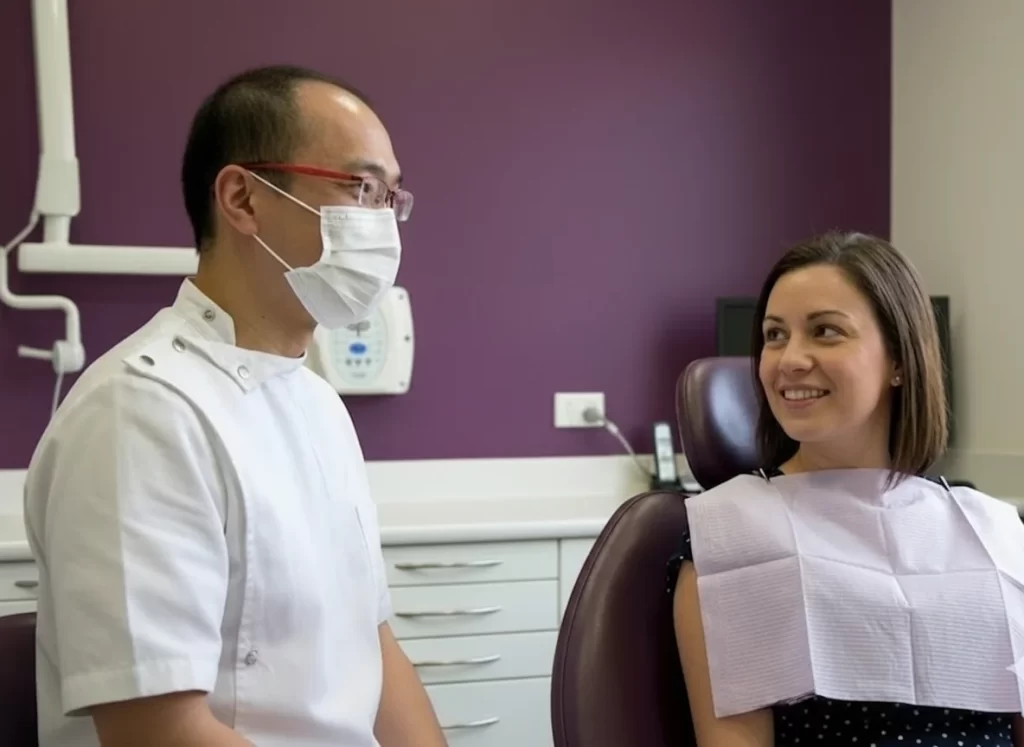
Every nervous patient starts upright, in the chair, with an empty tray. No bib, no instruments, no light in your eyes. We talk about what has happened before, what specifically worries you, and what you would like to be different. That first conversation can take twenty minutes and it is not wasted time. It is the appointment.
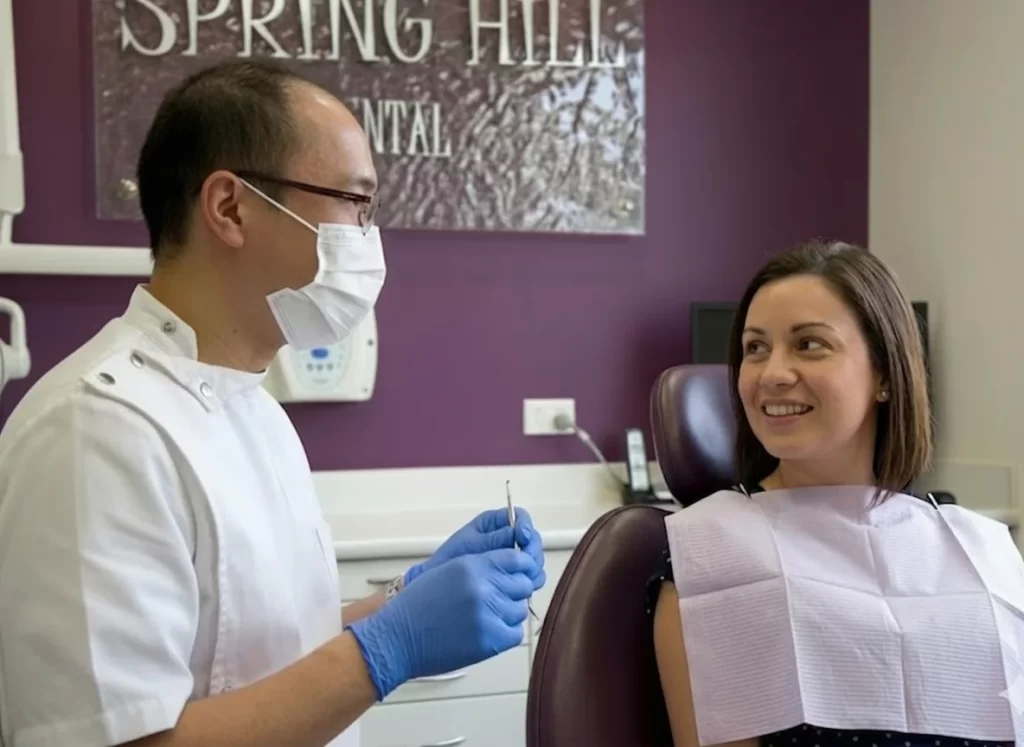
Then we agree on a stop signal. Your left hand goes up, everything stops. Not “let me just finish this bit”. Stops. You keep that signal for every visit afterwards, and you never have to explain or justify using it. Some patients use it four times in a visit, some never use it at all, and both are completely fine. Knowing it exists is usually the thing that lets people relax in the first place.
Our appointments are deliberately longer than the industry standard. Rushing is the enemy here. A nervous mouth needs time to go numb properly, time for the tell, show, do conversation, and time to sit up and breathe if that is what is needed. If we run behind because of it, that is my problem, not yours.
A few specifics on comfort, because vague reassurance is not worth much:
- Numbing is done in stages. Topical gel first, so the surface is already numb. Then the injection goes in slowly, warmed, and small. We wait for it to work properly and test before we start, rather than assuming and getting a surprise.
- Nothing happens without warning. Tell, show, do: we explain what is coming, show you the instrument, then use it. No surprises from behind.
- You can stop and sit up. Any time, for any reason. A break is not a setback.
- Bring your headphones. We have in-chair entertainment, but your own playlist or podcast beats ours. A blanket is available, and we can dim the light if the glare is part of the problem.
- We work around a gag reflex rather than fighting it. Shorter bursts, sitting more upright, rinsing more often, and stopping before it builds.
- We book nervous patients early in the day where we can. Fear is worse when you have had all day to think about it.
- We will never ambush you with a treatment plan. One thing at a time is a legitimate plan. Sometimes the first visit is a clean and a look, and the rest can wait for next time.
- If your fear needs more than gentle, unhurried care, we will say so. That conversation is part of being honest. Sedation is not something we provide in-house, and if that is what you need, we will tell you rather than talk you into something that will not work.
What Your First Visit Actually Looks Like
For anyone who finds the unknown worse than the known, here is the whole thing, start to finish.
In the waiting room. You check in at the desk, and you can say “I’m nervous” quietly if you would rather not announce it. It goes on your file so you do not have to repeat it to three different people. Nobody will make a fuss. You can wait in the car and text us if the waiting room itself is too much.
In the chair. We start sitting up, talking. What brought you in, what has happened before, what you are worried about. If you are only here to talk, we stop there and that is a complete appointment.
The look. A mirror first, so you can see what I see. Then a gentle check with the probe, telling you what I am doing as I go. X-rays only if they will change the decision, and you can decline them on the day if you would rather come back for them.
The conversation. What I found, in plain English. What I would recommend, what else is possible, what happens if we do nothing, and what each of those costs. You will get it in writing. You do not have to decide in the chair.
The end. You leave with a plan, not a surprise. If the plan is “nothing urgent, see you in six months”, that is a good day for everyone.
Dental Anxiety FAQ
These are the questions we hear most often from nervous patients. If yours is not here, ask it when you book and we will answer it honestly.
1. Is it normal to cry or shake at the dentist?
Completely. It happens here more often than you would guess, and it is embarrassing to nobody but the person doing it. We will give you a moment, and we will not make it a thing.
2. Can I bring someone with me into the room?
Yes. A partner, a friend, a parent, an adult child. If having a hand to hold makes the appointment possible, bring the hand.
3. How do I tell you I'm nervous?
Three words at the time of booking is enough: “I’m nervous.” You do not need to explain it, diagnose it, or apologise for it. We will book the appointment differently because of it, with a longer slot and a talk first.
4. What if I need a lot of work and I'm too scared to start?
Then we start with the smallest useful piece. Often that is a clean and a conversation. Root canal treatment, crowns and gum treatment are common fears, and there is no rule that says they all happen this month. We sequence it so each visit is something you can walk out of feeling okay about. If it is the root canal part that worries you most, our guide to when a tooth actually needs root canal treatment explains it in plain English.
5. Is sedation available?
Not at our practice. If your anxiety is at a level where you would need it, tell us on the phone and we will be honest about whether we are the right people to help, rather than booking you into something that will not work for you.
6. Will you tell me the cost before you start?
Always. Written and itemised, before treatment, with your health fund rebate explained and the gap pointed out. We claim on the spot through HICAPS so you only pay the gap on the day.
The Night Before and the Morning Of
Small things that genuinely help, from people who have been where you are:
- Book the first appointment of the day if you can. Less time to think, less time for the waiting room to fill up.
- Eat something. An empty stomach makes adrenaline worse and makes you more likely to feel faint. Something plain and light is plenty.
- Go easy on the coffee. One is fine. Three will make your heart race before you have even left the house.
- Write your questions down. Fear makes people forget the one thing they wanted to ask. A note on your phone is enough.
- Bring headphones and a charged phone. Music, a podcast, an audiobook. Something familiar that you can disappear into.
- Try slow breathing in the car. In for four, hold for four, out for six. It sounds soft, and it works on the vagus nerve.
- Plan something nice afterwards. A coffee, a walk, a phone call. It gives the day a different ending in your head.
- Tell us at the desk if you are struggling. We can give you a quiet room, a few minutes, or reschedule. Nobody will be annoyed with you.
If it has been a long time, you are not starting from scratch. You are starting from here, which is the only place anyone can start. And if you would like to read something calmer before you come in, our guide to what actually happens at a six-monthly check-up is a gentle place to start.
If You Have Been Putting This Off, Start With a Chat
If you have been carrying this around for years, the bravest version of this is not a filling or an extraction. It is a phone call, or a booking, or an email that says “I’m nervous, can we just talk first”. That is a real appointment in our books, and in my experience it is the one that changes things.
You can reach our Spring Hill practice on (07) 3236 9298 or pop in – we’re at 1/363 Turbot Street, right next to Woolworths. We keep same-day appointments available for anyone in pain, and nervous patients, returning patients and people who have not seen a dentist in a decade are all genuinely welcome. If you would like to see what else we look after, our full list of services is here.
Chat first. Drill later.
New patients are always welcome. We'll take the time to understand what's going on and walk you through your options - with no pressure to commit to anything on the day.
